
mon-fri 9-13 / 14.30-18.30
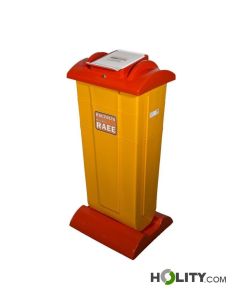
Container for micro WEEE waste collection. Capacity: 90 liters. Material: polyethylene with the rotational molding technique. Ballastable base.
Micro WEEE containers represent an essential solution in the management of small waste electrical and electronic equipment, governed by European and Italian regulations on separate collection. These devices allow for the separate collection of components such as chargers, small appliances, portable IT equipment, and other scrap gear, preserving the environment and facilitating the recovery of valuable materials. The choice of the appropriate container depends on multiple factors: volumetric capacity, construction material, mechanical resistance, and compliance with current environmental regulations. Public and private organizations, from local authorities to companies, require robust and reliable containers to ensure compliant collection and efficient management logistics.
The separate collection of micro WEEE is of crucial importance in the contemporary environmental management landscape. Dedicated containers perform a strategic function in separating small electronic waste from the general stream, preventing the dispersion of hazardous substances into the soil and water. A specific container for micro WEEE guarantees documentary traceability, facilitates inspection checks, and allows organizations to demonstrate compliance with environmental regulations. Public entities, educational institutions, public offices, and private companies benefit from the orderly management of electronic waste, reducing irregular disposal costs and improving corporate reputation through transparent communication towards stakeholders and local communities.
Practical advantages manifest daily in logistical operations: suitable containers reduce the risk of accidental spills, allow for efficient loading onto transport vehicles, and simplify the administrative documentation required by the competent authorities. The availability of specific models, differentiated by capacity and materials, allows every organization to find the solution that best fits its operational context, the volumes of waste generated, and the available physical spaces. Entities that correctly manage micro WEEE through appropriate containers also gain competitive advantages in the environmental sustainability landscape, an increasingly relevant element in corporate social responsibility evaluations.
The micro WEEE container market offers various construction variants, each optimized for specific conditions of use and collection volumes. Polypropylene (PP) models represent the lightest and most manageable solution, ideal for indoor environments with low traffic, characterized by high recyclability and ease of cleaning. Polyethylene containers made with the rotational molding technique offer greater structural robustness and impact resistance, particularly suitable for outdoor installations or in contexts where the container undergoes frequent mechanical stress. Galvanized steel models represent the most durable solution, suitable for high-traffic environments, public spaces, and situations where the longevity of the device is a priority. Some containers include coated or ballastable concrete bases, ensuring stability even in windy conditions or on uneven surfaces, while others provide portable solutions for installation in specific rooms.
Available volumetric capacities generally range from 70 to 105 liters, allowing the container to be adapted to the generated waste flows. Smaller capacity models suit small offices, professional studios, and retail points, while 90-105 liter versions are more appropriate for schools, hospitals, public administrations, and medium-sized companies. The choice of material also depends on the climatic context: galvanized steel maintains its structural properties in intense sun and rain conditions, polyethylene resists UV rays well but with lower impact resistance, and polypropylene is suitable for controlled environments. It is also necessary to consider the frequency of exposure to atmospheric agents, proximity to heat sources or extreme cold, and the type of surface on which the container will be placed.
The selection of a micro WEEE container must begin with a quantitative assessment: it is necessary to estimate the monthly volume of electronic waste generated by the organization and determine the available emptying frequency. An underestimation of capacity leads to frequent overflows and risks of regulatory violations, while over-dimensioning leads to logistical inefficiencies and unnecessary space occupation. The location of the container significantly influences the choice of material: a climate-controlled indoor environment allows for the use of lightweight polypropylene, while an outdoor installation requires more resistant materials such as polyethylene or galvanized steel. It is essential to also evaluate accessibility: the container must be positioned in a place easily reachable by the personnel in charge of collection, with margins of free space for handling and loading operations onto transport vehicles. High public traffic environments (such as schools, hospitals, offices) require particularly robust and stable containers, while private installations can tolerate lighter solutions.
Frequent errors concern the failure to consider the specific regulations applicable in one’s region: some local administrations impose specific dimensions, colors, or markings on micro WEEE containers. Inadequate planning of emptying logistics leads to uncontrolled accumulations and potential environmental risks; it is advisable to coordinate the optimal time interval with the collection manager and verify that the container complies with road transport regulations. Furthermore, the lack of clear and legible labeling can cause waste misclassification: every container must be unequivocally identified as suitable for micro WEEE collection. Finally, neglecting container maintenance reduces its operational life; polyethylene and polypropylene models require periodic rinsing to prevent dirt build-up, while steel ones need regular anti-rust inspections.
The management of electrical and electronic waste in Italy is governed by Legislative Decree 49/2014, which transposes the WEEE Directive 2012/19/EU. This regulation establishes separate collection obligations for producers and holders of WEEE, dividing waste into specific categories. Micro WEEE typically falls under the category of small-sized equipment and must be collected separately from common waste to allow the recovery of critical raw materials such as precious metals, copper, aluminum, and reusable components. Containers must be clearly identifiable through labeling compliant with regional guidelines, indicating the type of waste accepted and the contact details of the authorized manager. Technical standards require that containers resist ordinary mechanical stresses, maintain structural integrity under normal climatic conditions, and facilitate loading and transport operations without involuntary dispersion of materials.
Regulatory compliance requires that the container be certified for its intended use and that the organization maintains documentation certifying the traceability of the waste delivered. Many regional and municipal administrations provide technical specifications regarding minimum dimensions, standardized colors (often white or standardized variants), and mandatory signage. Safety is a recurring aspect: containers must not have sharp edges or dangerous moving parts, must have adequate stability to prevent accidental tipping during collection operations, and in the case of use in public areas, must meet specific standards of resistance to vandalism. Environmental compliance aspects also require that the containers themselves be made of materials compatible with economic circularity, preferably recyclable or partially made from recycled material, in consistency with the principles of the circular economy promoted by European legislation.
Explore all products in the category and compare the available solutions to find the one best suited to your operational context, considering volumetric capacity, construction material, and the regulatory compliance required by your local administration.
Micro WEEE includes small electrical and electronic equipment (chargers, mice, keyboards, adapters) and must be collected separately from larger WEEE according to European regulations. This distinction simplifies transport and disposal operations, reducing logistical costs and facilitating the recovery of specific components present in small-format devices.
A public office with 50-80 employees typically generates 15-25 kg of micro WEEE per month. A 90-105 liter container, emptied monthly, represents the appropriate solution. This capacity prevents overflow and allows for rational collection frequencies, easily coordinated with authorized electronic waste managers in most territorial contexts.
Yes, provided you use models specifically designed for outdoor use, made of galvanized steel or rotational polyethylene with a ballastable or concrete base. These materials resist rain, direct sun, and thermal variations. Before installation, check local regulations regarding additional protections or drainage systems required in your area.
Perform quarterly visual inspections verifying structural integrity, labeling effectiveness, and the absence of deterioration. For metal models, check for the absence of rust; for plastic ones, check for cracks or permanent deformations. Maintain documentary records of emptyings and maintenance dates, regularly coordinating with the authorized collection manager and the competent local administration.
Rotational polyethylene represents the optimal compromise: it costs less than galvanized steel but offers significantly higher resistance than polypropylene. In indoor environments with moderate traffic, polypropylene is economical; for prolonged outdoor installations, galvanized steel guarantees twenty years of life despite a higher initial investment.
Place the container in easily accessible common areas (teachers’ lounge, administration office, IT lab) away from heat sources and excessive humidity. In schools with multiple buildings, distribute multiple containers of moderate capacity (70-90 liters) instead of a single central container, reducing internal transport times and increasing user participation in separate collection.
It is not universally mandatory, but it is highly recommended in windy areas or areas with intense pedestrian traffic. Check the technical specifications provided by the manufacturer and the requirements of the local administration. The ballastable base represents a mobile alternative suitable when the placement of the container is not permanent or when the ground does not allow permanent fixings.
Post clear labeling with the international WEEE symbol, the text indication “Micro WEEE” and a short list of examples (chargers, earphones, mice). Organize periodic information briefings with the personnel responsible for collection. Communicative clarity significantly reduces waste misclassification phenomena and facilitates monitoring of regulatory compliance by control authorities.
 English
  Italian
 French
 German
 Spanish