
mon-fri 9-13 / 14.30-18.30

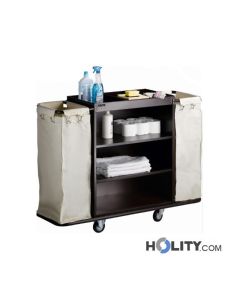
Professional extra-large laundry trolley in enameled steel with double bag holder and 3 large compartments. Equipped with an organized top shelf for courtesy sets and rubber bumpers. Dimensions: 1420x450 mm.
The management of textile flows within accommodation, healthcare, or industrial facilities represents a fundamental pillar of operational efficiency and the maintenance of hygienic standards. Laundry trolleys are not simple transport tools, but true logistical assets designed to optimize the timing of collection, sorting, and distribution of flat and shaped linens. In contexts where the volume of daily washes is high, the choice of ergonomic and resistant equipment becomes decisive in preventing premature wear of materials and, above all, in protecting the health of operators by reducing repeated physical exertion.
Integrating professional handling systems means investing in solutions that respect rigorous durability criteria, using materials such as stainless steel, aluminum, or high-density polymers, capable of withstanding heavy loads and frequent sanitization cycles. The versatility of this equipment allows it to adapt to narrow corridors, service elevators, and different types of flooring, always guaranteeing a fluidity of movement that minimizes the risk of hitches during the most intense work shifts. Proper planning of the trolley fleet is therefore the first step towards impeccable clean and dirty logistics.
The adoption of professional laundry trolleys responds to the need to rationalize work within laundries and housekeeping departments, where the volume of goods to be moved requires higher quality standards than consumer products. A technical trolley is designed to correctly balance the load weight, preventing the structure from buckling or the wheels from losing smoothness under pressure. This aspect is crucial not only for the longevity of the equipment but also for workplace safety, as smooth movement prevents musculoskeletal disorders resulting from excessive pushing or incorrect postures.
In addition to pure mechanical resistance, these tools offer intelligent compartmentalization that allows the separation of clean linen from dirty linen, avoiding cross-contamination that would compromise the healthiness of the environments. In HoReCa facilities, quiet operation is a further fundamental benefit: the use of rubber wheels with high-quality ball bearings ensures that pickup and delivery operations take place without causing disturbance to guests during rest hours. Choosing a professional model therefore means raising the level of service offered, guaranteeing speed of execution and orderly management of sheets, towels, and staff uniforms.
Another strategic advantage lies in the ease of maintenance and sanitization of surfaces, an essential feature in the medical and hospital sectors. The materials used for the construction of trolleys for hotels and hospitals are tested to withstand aggressive chemical agents and high temperatures, allowing deep cleaning that eliminates bacterial loads and organic residues.
The possibility of configuring the trolleys with specific accessories, such as pedals for opening the bag or colored lids for wash coding, transforms the tool into a complete organizational system. In this way, human error is drastically reduced and the workflow becomes intuitive even for new or training staff, consolidating a smooth and constant working method over time.
The range of laundry trolleys is extremely varied to meet specific logistical needs. One of the main distinctions concerns bag trolleys, ideal for collecting dirty laundry, which can accommodate one or more canvas or polyester bags, often equipped with quick-closing systems. These models are particularly appreciated for their lightness and for the ability to be folded when not in use, optimizing space in warehouses.
Conversely, shelf trolleys, often made of metal or polypropylene, are designed for the distribution of clean laundry; the shelves allow the linen to be kept folded and tidy, protecting it from dust and humidity during the journey from the laundry to the rooms or departments. There are also hybrid versions that integrate areas for dirty laundry and shelves for clean laundry, optimizing every single movement of the operator.
For industrial contexts or large healthcare facilities, solid-walled or perforated aluminum laundry trolleys are often used, known as roll-containers or trolley cupboards. These guarantee total protection of the contents and can be sealed for external transport to centralized laundries. Variants with a rising base are a cutting-edge technical solution: thanks to a spring system, the load platform rises or falls based on the weight of the laundry, always keeping the contents at the ideal ergonomic height for the operator, drastically reducing back bending.
Finally, we must not forget specialized trolleys for the medical sector, built with antibacterial materials and equipped with hermetic sealing systems for transporting potentially infected linen, guaranteeing the maximum biological isolation required by international health protocols.
Identifying the ideal trolley requires a careful analysis of internal flows and the structural characteristics of the building. The first criterion to evaluate is the load capacity, expressed in both liters and kilograms; oversizing a trolley can make maneuvers difficult in narrow spaces, while undersizing it forces an excessive number of trips, reducing overall efficiency. It is essential to measure the width of doors, elevators, and corridors to ensure that the chosen model can pass easily without damaging walls or door frames.
Another determining factor is the type of flooring: larger diameter wheels (125-150 mm) are preferable for uneven surfaces or outdoor paths, while for carpets or smooth floors, one can opt for standard wheels with non-marking gray rubber treads, essential for not leaving unsightly marks on the prestigious floors of hotels.
The operating environment also suggests the most suitable material: stainless steel is the choice for laundries where humidity is constant, as it prevents the formation of rust that would irretrievably stain fabrics. In contexts where noise is a critical factor, high-impact plastic or aluminum models are quieter than entirely metallic ones. A common mistake to avoid is underestimating the quality of accessories, such as parking brakes or corner bumpers.
These latter are vital for preserving the integrity of the trolley and surrounding furnishings in the event of accidental impacts. Furthermore, for dirty laundry, it is advisable to opt for water-repellent bags or bags with an internal PVC coating, which prevent the leakage of liquids or bad odors during parking in the corridors, raising the standard of hygiene and decorum of the facility.
The use of laundry trolleys in a professional setting is subject to various regulations regarding both workplace safety and public hygiene. In Italy, Legislative Decree 81/08 establishes the criteria for the manual handling of loads, imposing the use of equipment that reduces the risk of injury to personnel.
Trolleys must therefore respect precise ergonomic requirements, with handles placed at standardized heights and rolling systems that require a pushing effort within the limits allowed by NIOSH tables. CE compliance is the minimum mandatory requirement certifying the product’s compliance with European directives on mechanical safety, ensuring that there are no sharp edges or entrapment points for the user.
In the healthcare sector, linen management must follow guidelines for the prevention of healthcare-associated infections (HAI). Trolleys intended for these environments must allow for complete sanitization according to hospital disinfection protocols and, in many cases, must be equipped with traceability systems or color coding to distinguish the flows of “infected” linen from “common” linen.
Even in the HoReCa sector, compliance with HACCP procedures can extend to textile management, especially for tablecloths and napkins used in catering areas, requiring that transport trolleys be maintained in such clean conditions as not to contaminate clean material. Ensuring that suppliers provide detailed technical sheets and certifications of conformity is an indispensable step to pass the inspections of the relevant bodies and guarantee a safe and compliant work environment.
Explore all products in the category and compare the available solutions to find the one best suited to your operational context.
In environments with a high concentration of humidity and vapors, it is essential to opt for stainless steel or anodized aluminum. These materials guarantee total resistance to corrosion and oxidation, avoiding the formation of rust that could permanently stain fabrics and compromise the structural integrity of the trolley itself over the long term.
The choice must be based on the number of beds and the frequency of linen changes. It is necessary to calculate the average volume of linen produced per floor and compare it with the transit dimensions of elevators and corridors. An oversized trolley obstructs passage, while one that is too small increases working times due to constant emptying.
Trolleys with a removable bag offer superior operational flexibility, as they allow the entire load to be detached and transported directly to the laundry without having to move the metal structure. Removable bags in polyester or plasticized canvas are also easily machine washable, ensuring higher hygienic standards compared to fixed systems.
To preserve delicate surfaces such as marble, resin, or parquet, it is essential to mount wheels with non-marking gray thermoplastic rubber treads. This material avoids the formation of black streaks and reduces noise during movement. For floors with deep joints or carpets, a minimum diameter of 125 millimeters is recommended to facilitate crossing obstacles.
Yes, there are models designed with hermetic sealing systems and pedal-operated lids to minimize manual contact. These trolleys often use water-soluble bags or heat-sealed plastic bags that are inserted directly into industrial washing machines, minimizing the dispersal of bacterial aerosols and protecting healthcare workers from biological risk.
The capacity varies significantly based on the structure: lightweight bag models usually support between 30 and 60 kilograms, while solid-walled aluminum trolleys or roll-containers can handle loads up to 300 or 500 kilograms. It is essential never to exceed the nominal capacity indicated by the manufacturer so as not to compromise the wheel bearings.
Rising base trolleys use an internal spring that automatically lifts the load platform as the weight decreases. This system is fundamental for ergonomics, as it allows the operator to pick up or deposit linen while always keeping the back straight, eliminating the repeated bending that is the main cause of lumbar injuries in the sector.
Certainly, most professional systems provide multi-bag configurations with lids of different colors (red, blue, yellow, green). This color coding facilitates immediate identification of the wash destination or type of fabric, optimizing sorting processes from the collection stage in rooms or hospital wards.
 English
  Italian
 French
 German
 Spanish